Do I need a technical cofounder?
From vibe to production as a solo founder
In Feb 2025, I was displaced from the LA fires, living out of the back apartment of my wife’s grandparents’ beach house, working with a career / executive leadership coach:
She said - “the quest is in the question” What do you want? What is the question you’d like to ask?
Can I be a tech founder? Do I need a technical cofounder? (so that I can solo found)
You see, I’ve been in this unique position for so much of my B2B SaaS tech career. Some would call me a solutions architect, sales engineer, product marketer, design engineer. Somewhere between sales, product, and the business operations. A generalist, with a strong understanding of users and a super power of putting together an awesome software demo.
I had written on a sticky note a few months earlier.
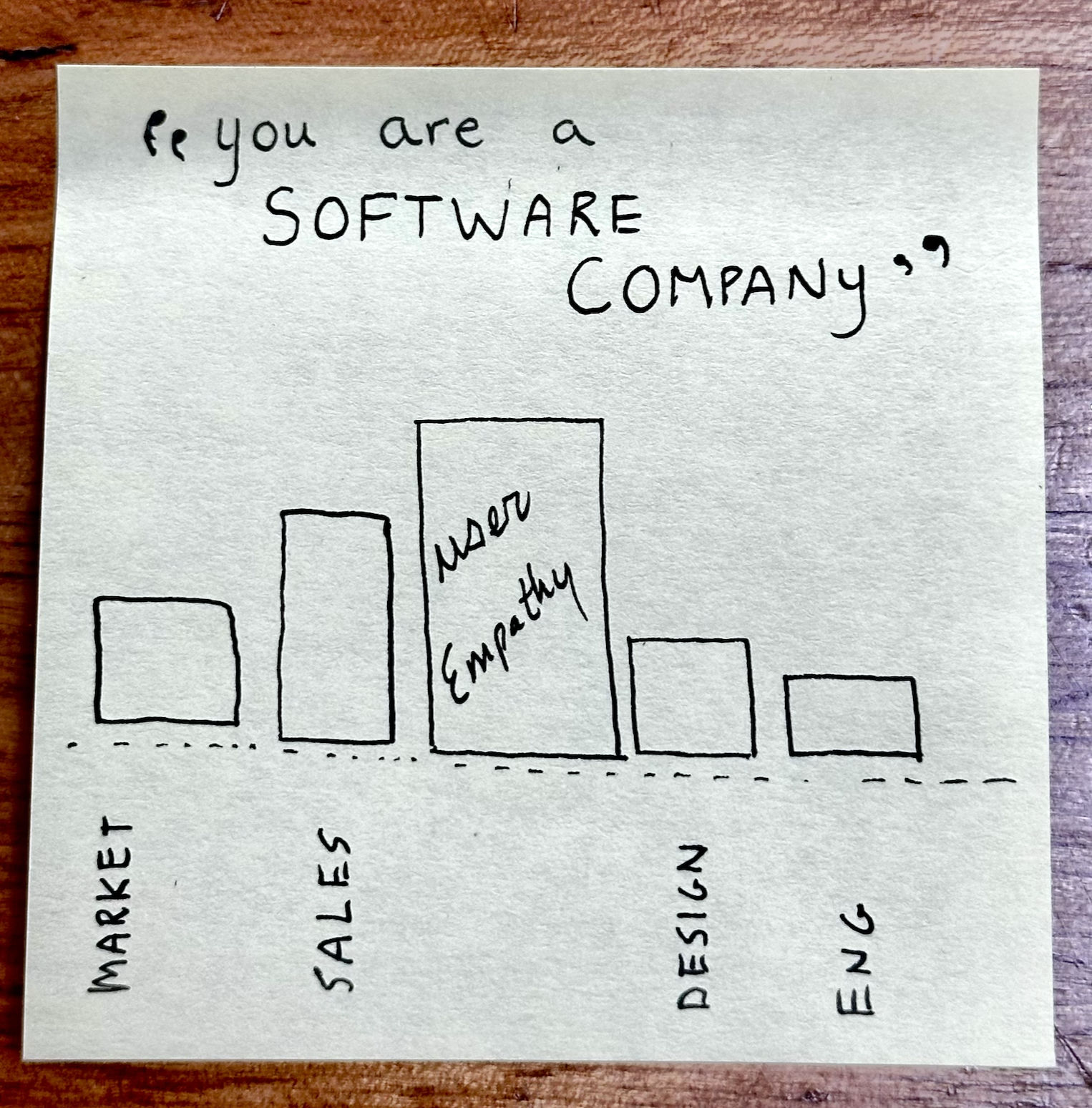
My wife joked “John, you’re not a software company. You are you. What are you talking about” And I said “No no. What I mean is, I think I have all the essential skills to create and run a software company. It’s about time I do this.”
A few months earlier, at Lenny’s Summit brought on by Coda, in October 2024. ChatGPT had just released publicly with GPT-3.5 two years before. I’m there helping to run the event and standing alongside the stage. Claire Vo stands up and shows concentric circles of the collapsing skill stack. Product, design, and engineering is overlapping; it may become one, she suggests, even warns. I think “the builder is back.”
Claire, a PM, was using a new tool called V0, created by Vercel. I had heard of neither.
Am I behind?
But I’m a builder. I always have been.
Sand castles. LEGOs. Paint. Pagemaker. Dreamweaver. InDesign night classes at community college. CS courses in college. Drupal. Excel VBA, Access. Business modeling and App script. Implementing Salesforce. Designing product mocks. Trello, Zapier, Wordpress The maker generation at Coda. Solution Studio with NoCode. Integrations. Templates and pseudo packaged software. And now this.
AI felt all hype until that moment. A silcon valley fever dream, led by Reid Hoffman, the largest investor in Coda. And Coda’s roadmap started bending to it. LLMs, RAG, Indexing, chatbot. I was pissed. Our clients weren’t asking for this. This was a VC play.
Vercel’s website said something different. They were talking about Design Engineers. It was a target persona, had its own /solutions/ marketing page. They had them on staff. I saw what they were saying but didn’t quite understand what it was saying.
Design systems — YES!!
Deploy speed — sure!
npm — huh?
edge — wuut??
I listened to Guillermo Rauch on podcasts. He created websockets, next.js, hired shadcn (of shadcnui typescript component library). One of the best developers in the world with good taste says.
Product builders
Builders, yes.
By this time, the Maker Generation targeting of Coda was dead. We had given up on that persona. It was an all-in-one workspace with some AI sprinkle dust on it.
Meanwhile, Vercel stands up a billboard on the Brooklyn Bridge “Just ship it” Fuck ya.
And then Coda gets acquired by Grammarly, a grammar writing assistant getting destroyed by the rising AI giants Claude (Anthropic), ChatGPT (OpenAI), and Gemini. Coda stock becomes Grammarly stock, a secondary with fresh debt financing capital led by Shishir. I sell all the stock I can.
So I’m sitting in Feb 2025, the fires sweep through LA, Coda is going through its own flames, and I’m starting to get into tinkering again. And have the time and space to explore.
First, the vibe coding tools:
- V0
- Lovable
- Bolt
- Replit
Lenny’s Newsletter features Colin Matthews, a technical PM who is showing how to use the tools. You can wire up some things to make a good prototype. He also mentions Windsurf and Cursor. They are IDEs — Integrated Development Environments. Huh?
I’d been frustrated with the “pure vibe code” tools. I could, within 1-3 prompts, get to something passable for a prototype. But it did nothing. And I couldn’t edit really anything by hand.
Can I be a tech founder with this stack? I don’t think so. Not the type of B2B SaaS stuff that I want to build. Stuff with an agentic layer on it. Nah.
So I download Windsurf. Confusing. Cursor. Oh, I sort of get where its heading; I was patient with it, myself. Like Vercel, it’s branding felt right; it resonated. I can tell they have taste. A fork of VS Code, didn’t get the meme then, didn’t care.
Claude’s Sonnet 3.5 turns 3.7 . It’s writing good code now. I can ask more general stuff and it can do it. It’s all in Cursor chat right now. I download my first GitHub open source repo package into Cursor, have it do everything for me. I think it’s FFMPEG. And it runs the program. It does what I need it to do. I’m building again. The computer is a machine that I have greater access to. The ceiling is opening up. The barrier to entry is dropping, the floor is giving out. We’re in free fall.
We’re in Spring 2025. I’ve been discussing taking a sabbatical with the company. It was time. I was gonna take it unpaid, but hit the Coda - Grammarly transition just right: take my last 2 weeks unlimited vacation and Grammarly’s 5-year as an employee 4 weeks paid, 6 weeks total. Spend a month in Portugal with my wife and 18-month old son and don’t touch any AI. It was easy to let go, didn’t miss it at all. I check email once or twice; the news of AI development breakthroughs is weekly. I know I’m getting behind; I don’t care.
I give it a week when I’m back to LA in April. We’re back to our home outside of Pasadena. But I can’t let it go. The 10pm to 2ams come back.
Can I be a tech founder? Do I need a technical cofounder?
The quest continues.
Two SWE ex-Codans have started a product called Subframe. I’m prototyping with front end code. It’s familiar; I’ve been in Figma for 7 years (Coda was a beta customer). I ask Ivan, one of the founders, “where’s the database, how do I deploy this thing?” “Oh no, you’ve got it all wrong. This is pure Typescript with Tailwind CSS. You build need to take this front end code and wire it up to the backend logic and data. You need to finish building the app”
So I hop on a call. npm install. Get it all together. npm dev and Localhost:3000. What am I looking at? It’s software in my browser but not on the internet. Huh, this is new.
Redditors lament “Ya, agentic coding is cool, but you can only build toy CRUD apps” So let’s build toy CRUD apps. It’s a beginning. It’s only going to get better. The slope is still exponential. Let’s keep going.
I start creating videos on YouTube, mostly for myself. I send one of myself, essentially failing in the building and deploying, to a buddy from college. The AI is hallucinating how to solve the localhost issue, port 3000 is in use. I don’t know what that means. I ask him “You know how to do react and python, right?” He’s a computational architect - that rare blend of designer and software engineer. Cassab: Let me help you.
So we start my 6 week bootcamp.
At the same time, I begin co-leading the #ai-design-prototyping group with a design technologist / motion designer from Apple who had just joined Grammarly. Even real designers are grappling with it. The engineers are talking but not doing much yet.
Week:
- Python
- React, .ts, components
- Backend - postgres and supabase/neon
- Data pipelines, APIs (FastAPI) and flows
- Vector databases, semantic search, and LLM
- Polish and demo -> ending in a demo day.
Week 7 - we begin pair programming. He’s at an architecture startup that’s incubating within Google X. He’s starting to learn the same stack, and moving faster than me. The engineers, or at least the group closer, are getting in.
Claude Code has launched. I’m in the terminal, single threading. Rolling. Waiting. But its hallucinating a ton. So I’m reading every line. Sometimes hand coding, copy and pasting from Stackoverflow or Reddit. Reading every guide (copy and pasting that guide into the terminal)
The motto in this phase: There are no shortcuts.
I keep on trying to vibe my way through features. Vibe my way out of bugs.
THERE ARE NO SHORTCUTS.
It’s now printed and taped to my wall. I may get it tattooed on my arm. It’s an .md file in my repo with an Ira Glass quote about the gap between your taste and your skill — how that gap makes people quit before their work ever catches up to their vision. It’s 1am and I.Just.Need.To.Fix.That.Bug.Please.Help.Claude.
No. There are no shortcuts. Come with the opinion. Be very very specific with what you want. And then go. Plan mode always. The vibes are minimal in the middle.
I begin reaching out to my community.
I started prototyping to learn with a CRM. But the very first person I named that I wanted to help was
- Vince, Sales Engineer.
A mentor once said that he built his entire startup around helping “Dave”, a friend who was trying to rent his high quality cameras out.
By this time, Vince is now a product manager. They don’t do many RFPs, but we’re running evals for improving the product quality.
I talk with my SE community: Katie, Corey, Bradford, even VCs and competitors in the space.
My prototype is localhost. I can’t get it off my computer. Ugh. The vectors in local storage. An electron utility app.
I talk with a solo founder, Fedor, and he says - start with the team features. I know I need to build them.
I’m stuck.
It’s August. I’m trying to climb my way out of the hole of getting everything online. I’m on Neon database that just sold to Databricks and is built for engineers. I like it. It’s just half a step too far away from me able to code on it.
I’ve created some demos. RFx is getting there. No website. I call the entire project Aero.ws so there is a home. I like the arrow, I like the AE in the name, I’m sitting in my great grandfather in law’s house, who was a Sales Engineer in 1920, an immigrant from Canada who started an Aerospace manufacturing company down the road. It’s all circling and cycling. I’ve got to get it out.
Spin up a CRM. Write down every SE I know. Reach out. I’m getting good demos. Some validation on the positioning and messaging. 17 calls in September, including mentor conversations (Sales / VCs). The pitch (Figma slides with light prototypes) is strong. It has me all over it. I’m feeling seen as an SE. I like these people, these problems. This is the space I’d like to be in. Casually lurking in r/salesengineer. These are the problems - technical docs, demos, “stuck” between sales and product. These are my heros who I want to serve.
I have my first real demo with a person Corey brought into the evaluation. They are evaluating Loopio. It’s a bake off. But RFx is a toy app compared to it. “This is nice” says Grant. I get a debrief call with Corey, I can’t get a next one. I said I’d keep them updated on the roadmap. I’ve got a huge backlog.
But this entire time, I know under the hood, that the AI has hallucinated security. I can see it, and Claude is trying to convince me otherwise. I can see the direct PSQL. And Neon doesn’t have baked in auth. I try a totally new app design from scratch. It’s slow. Its sort of working. I’m not impressed, no one is.
Then I get a hot referral to trial the tool
A guy named John — different John — intro’d by Corey, is starting to show it to his sales leadership and CMO. Oh shit. I spend an entire weekend taking the prototype and making it ready for him. Smooth out everything. It’s still fragile but it’s Cursor to Git to Vercel and the code to production pipeline is flowing. My main branch now has protection turned on. I’m doing PRs.
I need it to demo well. The design system is iterations over each other. It looks so bad.
By this time, I’m now pair programming weekly with Cassab. He’s building a recipe tracker and learning all the same stack. We’re vibing off of each other’s designs. He’s pushing the agentic edge of the abilities. I’m pulling that back into the app. Give it tool calls, the agents want the tools.
The trial continues — we’re getting sales leadership involved. In the new year, I incorporate Aero as the company, and the product becomes OurFX after my wife, Kelsey, asks Claude chat for a website idea and it fully codes the landing page, not what she expected and she’s very excited.
Pull out Neon, put in Supabase. Do all the real security. Get the business buttoned up. A real demo. A real proposal in January 2026.
The answer is “No” They aren’t doing enough RFPs.
So this is where I was. At the end of a sprint, but also of a year of working on this. At “No”
But the answer was actually “yes” all along. In the becoming.
Can I be a technical, solo founder?
Yes. Yes, I can.
And I have fresh fire of motivation. The “No” frees me. I’ve been saying yes to myself and to this project. Would I do this again knowing what I know now? “Hell ya”
With no users in the system. I shift from SLG to PLG (sales-led to product-led growth).
I do everything I wanted to do. All the things that I was hiding with demos, that I could no longer hide if I wanted to do self serve. To build a real product. To finish what I started:
- Google Auth
- Stripe for payments
- Actual onboarding
- Pricing plans
- A good-looking marketing site with sharper messaging and actual product screenshots.
I go full SWE. Full PMM. Full-stack. And I’m moving fast. Faster than ever once I let go of hiding behind narrative and slide decks. I’m writing the actual copy, no LLM. I’m designing the actual things with sharp opinions, Claude Code is implementing. I begin running two Claude sessions - one for the marketing site, one for the backend. I begin worktrees, I’m at 3 concurrent sessions.
I fly out to Dallas for Sales Kickoff (SKO) for Superhuman. I’m writing content on the plane - I’m in VS Code, writing in markdown, in zen mode, no internet. It’s all coming out of me. I’m posting in r/salesengineer and getting the most popular posts for the day, then week, then month. I know this SE crew. I am an SE. I’m calling out Arphie and other RFP tools for astroturfing — learning what that even is — and working with the mods to protect the community. I can now see that astroturf pattern everywhere I look. These are growth hackers, not community growers. They want to harvest the MRR for their VC, not build for them. There are more competitors than I had even imagined - Iris, Conveyor, Loopio, 1Up, the list goes on. It’s an obvious intersection of the the problem and solution abilties, there’s money here in this solution, from this community.
I’ve been partnering with an SE closely on a SKO demo. He’s getting really into this agentic coding too. Our flights are departing from neighboring gates at Dallas Love airport. I demo OurFX. He’s into it. He’s been developing a security product on his own time - doing bug bounty. He runs it on OurFX. The software is getting solid.
A designer gets let go from Superhuman who was part of #ai-design-prototyping. He DMs me on LinkedIn. He does design systems and wants to get more into design engineering. I share that OurFX is the perfect project — he’s in. I invite him into the repo and we’re doing weekly design/code reviews. I then spend the weekends refactoring, running unit and e2e tests, and deploying to main. We’re moving faster. I’m now looking over PDE and focusing on GTM. I’m writing content. Getting it out.
First r/salesengineering call is tomorrow with an SE who is interested in CoWork and demo automation. I shared my mini playbook from the OurFX site. I’ve updated by linkedin profile, back on X / Twitter. In a presales Slack private group. Getting closer, getting closer.
I haven’t needed a technical cofounder yet.
Last year, I thought AI was the answer to the technical cofounder question. Like the actual, end state answer — to be my technical cofounder. I write the requirements. It does the thing.
But what happened through AI as a tutor, pair programmer, me offloading some of the coding to the machines and learning CI/CD, SDLC, design docs, and the underlying technology, is that I took on the role of this new type of CTO.
It now takes almost nothing to start of business.
The only moat now is:
Ship early and often, for your users.
And so that’s how Aero is born. We ship early and often, for our users. We use the full stack of agentic development to decrease time to market, invite our clients in as design partners, don’t take VC, but rather take real money from our users so that our goals are fully aligned with our client’s ambitions.
Call me what you want. A founder. A design engineer, solution architect, sales engineer, product marketer.
I’m a builder. Fuck the labels. Just go out and ship it.